 Domain RegistrationFind and register the perfect domain for your website.
 .COM DomainChoose a widely recognized domain to build global credibility.
 Domain TransferSeamless domain transfers with zero downtime and complete control.
 All TLDsFind and register your perfect domain. Choose from local and global extensions.
 SSL CertificatesKeep your website safe with reliable SSL Certificates that protect customer data and build trust.
 whoisCheck domain ownership details, expiration dates, and registrar information.
 US DomainRegister a .US domain and build trust in the USA.
 Web HostingEverything your website needs to run smoothly
 WordPress HostingWordPress hosting that just works
 Windows HostingReliable hosting for Windows environments
 Reseller HostingTurn hosting into your business
 Email HostingEmail that looks professional and works anywhere
 cPanel HostingFull control of your hosting with cPanel
 Affiliate ProgramJoin as a partner and earn commissions on every referral you send our way.
 Vps HostingScalable virtual servers that expand as you need.
 Dedicated ServersGet complete access and full control over your dedicated physical server.
 Managed vpsNot tech-savvy? We will take care of everything with our fully managed VPS hosting for you.
 AI Website BuilderCreate stunning websites in seconds with AI.
 Online ShopSet up a professional online store. No coding required.
 Web design serviceGet a tailored website designed to match your brand and support your goals.
 BlogFind helpful guides on web hosting, online selling, digital marketing, and more.
 Contact USYou can reach us anytime, day or night, through chat or email.
 SupportBrowse helpful guides and answers for all of our services.
Have you ever clicked “add to cart” on a domain name, only to discover the price doubles next year? Or you may be staring at your screen right now, confused about why one domain costs $1 while another costs $60 for basically the same thing.
Well, the registration price looks fantastic, but then you notice the renewal cost and feel misled entirely. Some extensions advertise rock-bottom prices that mysteriously skyrocket after twelve months. Others seem overpriced from the start, leaving you wondering if you’re being ripped off.
The confusion gets worse when you’re comparing options. Why does a .com cost more than a .info? What’s the difference between registration, renewal, and transfer fees? And most importantly, what are you even getting for your money?
Here’s what we’ll break down in simple terms:
- Exact pricing for popular domain extensions at Truehost
- Why some domains cost $1 while others cost $60
- The sneaky renewal rates you need to watch
- What you’re paying for when you buy a domain
- Smart ways to save money on your purchase
Let’s cut through the confusion and get you the straight facts.
The Real Domain Name Cost at Truehost
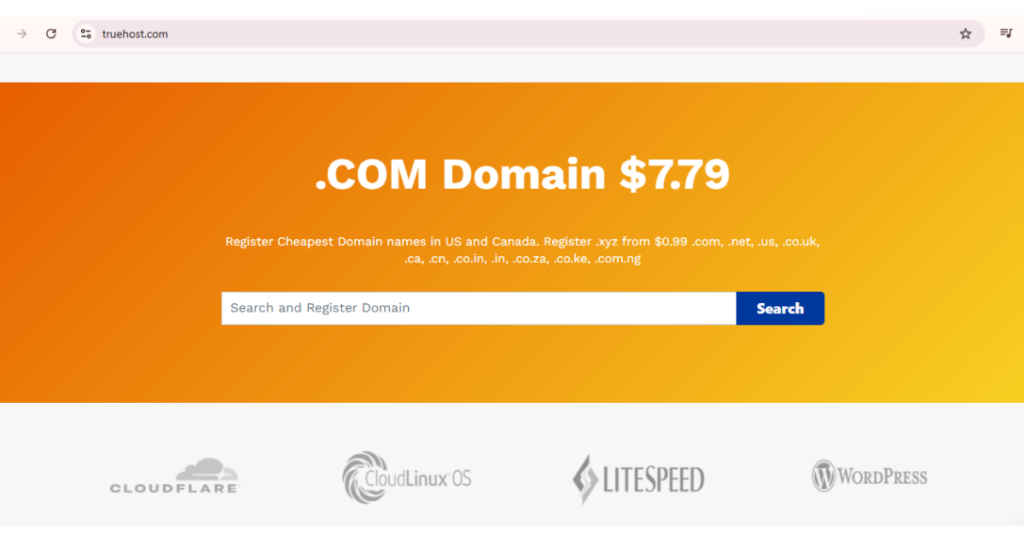
Before we explain anything else, let’s put the actual numbers on the table. At Truehost, the domain name cost varies wildly depending on which extension you choose.
The cheapest option is a .top domain at just $1.00 for your first year. Yes, one dollar. That’s less than a candy bar. However, when that first year ends, you’ll pay $5.14 to keep it for another year.
On the opposite end, a .tech domain starts at $9.23 but jumps to $59.27 for renewal. That’s a massive leap that catches people off guard if they’re not paying attention.
The most popular choice, a .com domain, sits comfortably in the middle at $7.79 for registration and $9.69 for renewal. This pricing explains why 52% of all websites worldwide use the .com extension.
Here’s a quick snapshot of what you’ll pay.
Budget-friendly options include .top at $1.00, .us at $1.99, and both .online and .site at $2.87 for registration. These low entry prices make them tempting for first-time buyers.
Mid-range choices like .com at $7.79, .uk at $7.07, and .org at $10.67 offer solid credibility without breaking your budget.
Premium extensions such as .io at $41.27 and .Airforce at $32.87 costs significantly more but targets specific audiences who value these specialized endings.
Transfer fees also vary. Moving a .uk domain to Truehost costs $6.47, while transferring a .tech domain costs $56.87. These fees always include one extra year of registration, so you’re not just paying to move; you’re adding time to your ownership.
Quick Price Comparison Table
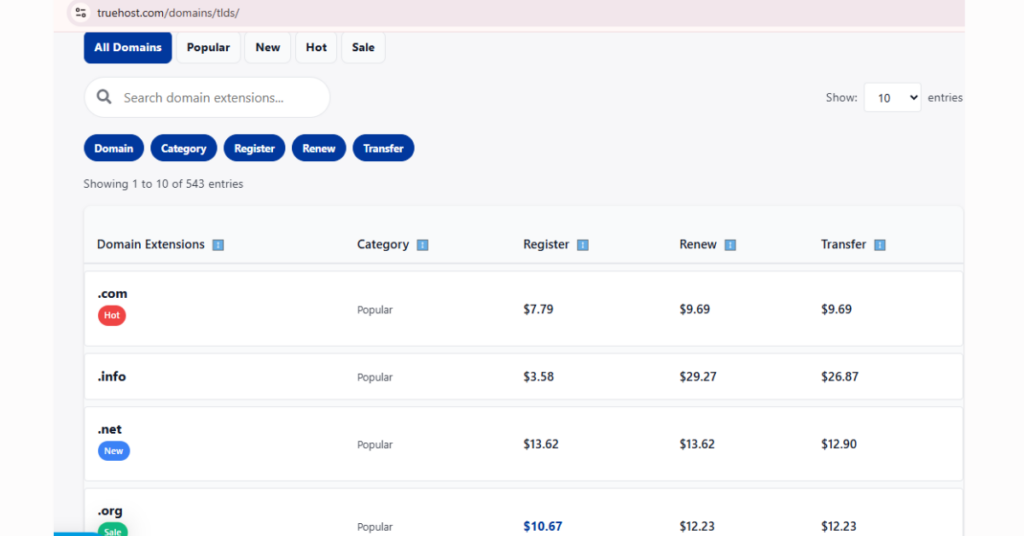
The table below presents the full Truehost pricing for the most hot, popular, and common domain extensions.
| Extension | Category | Register | Renew | Transfer |
| .com | Hot/Popular | $7.79 | $9.69 | $9.69 |
| .info | Popular | $3.58 | $29.27 | $26.87 |
| .net | New/Popular | $13.62 | $13.62 | $12.90 |
| .org | Sale/Popular | $10.67 | $12.23 | $12.23 |
| .Airforce | Special/Premium | $32.87 | $32.87 | $31.67 |
| .online | Popular | $2.87 | $31.67 | $30.47 |
| .site | Popular | $2.87 | $34.07 | $32.87 |
| .top | Popular | $1.00 | $5.14 | $5.02 |
| .uk | Popular | $7.07 | $7.07 | $6.47 |
| .us | Popular | $1.99 | $8.87 | $8.27 |
| .io | Popular | $41.27 | $56.87 | $55.67 |
| .tech | Other | $9.23 | $59.27 | $56.87 |
Why Domain Name Cost Varies So Much
The domain name cost you see isn’t random. Several clear factors determine why you pay what you pay.
A. Popularity drives pricing.
Extensions that everyone wants cost more because demand is high. The .com extension remains the king of domains, recognized and trusted worldwide. When you register a .com, you’re paying for the universal recognition and credibility it offers.
Think of it like real estate.
A storefront on Main Street costs more than one on a side street. Both serve the same function, but their location values differ. Similarly, a .com domain costs more than a .info because customers instantly recognize and trust it.
Growthbadger shows that users are 3.8 times more likely to assume a website ending in .com is legitimate than one ending in a newer extension. This trust factor alone justifies the higher registration fee.
B. Registry costs vary by extension.
Each domain ending is controlled by a registry organization that sets wholesale prices. These registries charge different amounts based on their operational costs, market positioning, and business strategies.
The .io extension costs $41.27 because the registry targets tech companies willing to pay premium prices. Meanwhile, .top sells for $1.00 because the registry wants rapid adoption and market share growth.
C. Promotional strategies affect what you pay.
Registrars like Truehost offer discounted first-year pricing to attract new customers. The .org extension currently sits in the “Sale” category at $10.67, reduced from its standard rate. These promotions help you save money upfront, but typically reset to regular pricing at renewal.
D. Renewal economics play a role.
The massive gap between registration and renewal prices for extensions like .info ($3.58 versus $29.27) and .online ($2.87 versus $31.67) reflects promotional pricing strategies. Registrars hook you with a bargain, then collect the real revenue on renewals.
This pricing model works because once you’ve built your website, set up email addresses, and printed business cards with your domain, you’re unlikely to abandon it due to a price increase. Studies indicate that 89% of domain owners renew at the regular rate rather than migrate to cheaper alternatives.
E. Market positioning influences domain name cost.
Specialty extensions like .tech and .io deliberately charge higher prices to maintain premium positioning. They want to attract serious businesses, not hobbyists, so they use pricing as a filter.
Breaking Down Registration, Renewal, and Transfer Costs
Three different prices appear when you’re shopping for domains: registration, renewal, and transfer. Each one means something specific.
Registration is what you pay to claim an available domain for the first time.
This is your entry fee, your ticket into domain ownership. At Truehost, registration prices range from $1.00 for .top domains to $41.27 for .io domains.
When you register a domain, you’re renting it for a year (or longer if you choose multi-year registration). You don’t own the domain forever. You’re leasing it from the global domain system, with the right to renew as long as you pay the rent.
Renewal pricing kicks in after your initial registration period ends.
This is where things get interesting, and frankly, where many people feel frustrated.
Some extensions maintain consistent pricing. The .uk domain costs $7.07 for both registration and renewal. What you see is what you get, year after year. The .net extension stays steady at $13.62 for both registration and renewal, making budgeting simple.
However, other extensions have dramatic price differences.
The .info domain registers for $3.58 but renews at $29.27, an 8x increase. The .online domain jumps from $2.87 to $31.67, an 11x multiplication. The .site extension follows a similar pattern, leaping from $2.87 to $34.07.
These renewal jumps exist because registrars use promotional pricing to acquire customers. They’re betting you’ll stick with your domain despite the price increase because switching causes hassle and disruption.
Transfer pricing applies when you move a domain from one registrar to another. Perhaps you’re unhappy with your current provider’s customer service, or you found better features elsewhere.
Transferring your domain to Truehost costs different amounts depending on the extension.
The .top domain transfers for $5.02, while.tech transfers cost $56.87. Remember, transfers always include one additional year of registration. So when you transfer a domain, you’re not just moving it, you’re also extending your ownership by twelve months.
Sometimes transferring saves money. If your current registrar charges $15 for .com renewal but Truehost’s transfer costs $9.69 (which includes a year), you’re saving $5.31 while also getting better service.
What You’re Paying For: Domain Features Explained
When you pay your domain name cost at Truehost, you’re not just buying a web address. You’re getting a bundle of features and rights that make your online presence possible.
Your payment includes full DNS management capabilities.
DNS stands for Domain Name System, the technology that connects your domain name to your actual website files. Through Truehost’s control panel, you can create and modify DNS records, point your domain to any hosting provider, and configure email routing.
You also get full access to the control panel.
This web-based interface lets you manage every aspect of your domain 24/7. Change nameservers, update contact information, enable security features, or configure subdomains. All from one dashboard.
Domain locking comes standard with your registration.
This security feature prevents anyone from transferring your domain to another registrar without your explicit permission. Considering that domain theft is a real problem, this protection is valuable. In 2025 alone, over 15,000 domain hijacking attempts were reported globally.
Auto-renewal options protect you from accidentally losing your domain.
Set it up once, and your domain automatically renews before expiration. This feature has saved countless businesses from the nightmare of domain expiration, which can cost $100+ in redemption fees to recover.
Email forwarding is another included feature.
Even if you don’t have email hosting yet, you can set up [email protected] to forward to your existing Gmail or other email account. This gives you professional-looking email addresses immediately.
Subdomain creation lets you organize different sections of your online presence.
Create blog.yourdomain.com for your blog, shop.yourdomain.com for your store, and support.yourdomain.com for customer service—all at no extra charge.
You receive domain forwarding capabilities, too.
Own multiple domains? Point all of them to your main website. Someone types in your .net domain? They automatically land on your .com site. This seamless redirection protects your brand and captures traffic from all your domains.
Technical support from Truehost’s team is part of your package.
When you’re configuring settings or need help with DNS changes, support staff can guide you through the process. For customers in the USA and America, local support means assistance during your business hours in the languages you prefer.
WHOIS privacy protection shields your personal information from public view.
When you register a domain, your contact details usually appear in public databases. Privacy protection masks this information, reducing spam emails and protecting your identity. Check whether Truehost offers this for free or charges an additional fee.
The Registration vs Renewal Reality Check
The biggest complaint about domain name cost involves the gap between registration and renewal prices. Let’s examine this honestly.
Some extensions maintain price consistency.
The .net domain costs $13.62 whether you’re registering or renewing. The .uk extension stays at $7.07 for both. These straightforward prices make budgeting easy and eliminate surprises.
Other extensions use aggressive promotional pricing.
The .info domain costs $3.58, but charges $29.27 annually after that. Over five years, you’ll pay a total of $120.66, an average of $24.13 per year, not the $3.58 you initially saw.
The online extension follows this pattern as well, starting at $2.87 and jumping to $31.67 for renewals. Your five-year cost totals $129.55, averaging $25.91 annually.
Before you judge these pricing strategies harshly, consider the economics.
Registrars compete fiercely for new customers. Promotional pricing attracts first-time buyers who might otherwise choose competitors. Once you’ve invested time building on your domain, renewal rates reflect actual operational costs plus reasonable profit margins.
Is this fair?
That depends on your perspective. Transparency is the key issue. Truehost displays both registration and renewal prices clearly, letting you calculate long-term costs before purchasing. This honesty helps you make informed decisions.
Smart buyers always check renewal rates before committing.
Calculate what you’ll pay over three to five years, not just the first year. A domain that costs $10 for registration and $12 for renewal might beat a domain that costs $3 for registration but $30 for renewal.
Budget-Friendly Domain Choices
If you’re observing your domain name costs, several smart options are available at Truehost.
The .top extension wins for pure affordability at $1.00 registration and $5.14 renewal. Your first five years total just $21.56. Less than many single-year costs for other extensions. However, .top domains carry less brand recognition, so weigh savings against credibility.
The .us extension offers substantial value at $1.99 registration and $8.87 renewal. For United States-based businesses, this combination of low cost and geographic relevance makes sense. Your five-year total comes to $37.47, which is still very affordable.
The .uk domain provides excellent consistency at $7.07 for both registration and renewal. UK businesses get geographic credibility without price surprises. Five years cost $35.35 total, and you know precisely what to budget annually.
For international businesses, the .com extension at $7.79 registration and $9.69 renewal represents smart spending. Yes, cheaper options exist, but .com’s universal recognition and trust often justify the modest premium.
Your five-year investment totals $46.55, averaging $9.31 annually.
Premium Domains: When Higher Costs Make Sense
Paying more for the domain name cost is the right move. Premium extensions serve specific purposes that justify their pricing.
The .io extension costs $41.27 for registration and $56.87 for renewal. These prices seem steep until you consider the target audience. Tech companies, startups, and SaaS businesses use .io domains to signal their industry focus.
When your competitors all use .io, it becomes your standard too.
The .Airforce extension at $32.87 across registration, renewal, and transfer serves military-related organizations and aerospace businesses. The specialized nature and limited target audience justify premium pricing.
The .tech extension illustrates why you should watch renewal costs carefully. At $9.23 for registration, it seems reasonable. But $59.27 for the renewal makes it expensive in the long term. Use .tech only if the industry alignment provides clear branding benefits.
Hidden Costs and Extra Fees
Beyond the listed domain name cost, a few additional charges might apply.
Every domain includes a mandatory ICANN fee of approximately $0.20 per year. ICANN (Internet Corporation for Assigned Names and Numbers) oversees the global domain system. This tiny charge supports their operations and is unavoidable.
Privacy protection may cost extra if Truehost doesn’t include it for free. Many registrars charge $5 to $15 annually for WHOIS privacy. Given the spam reduction and identity protection it provides, this fee is usually worth paying.
Domain redemption fees apply if you let your domain expire. Most registrars offer a grace period of 30 to 45 days during which you can renew at standard rates. After that, domains enter redemption status, with a $100 or more recovery fee. Auto-renewal eliminates this risk.
Multi-year registration sometimes includes small discounts. Registering for three or five years upfront might save a few dollars while locking in current pricing against future increases.
Smart Shopping Strategies
You can minimize your domain name cost with strategic choices.
First, always calculate the total cost of ownership. A domain that costs $3 for registration and $30 for renewal is more expensive over five years than a domain that costs $10 for both registration and renewal.
Second, register for multiple years when prices are favorable. If you find a great promotional rate, lock it in for as long as possible. Most registrars let you register for up to ten years upfront.
Third, take advantage of sales categories. Truehost marks specific extensions, such as .org, as “Sale” items with reduced pricing. These promotions save money on quality extensions.
Fourth, consider transferring instead of renewing if it’s cheaper. Sometimes transferring a domain (which includes a year extension) costs less than renewing with your current provider.
Fifth, buy variations of your main domain to protect your brand.
If you register ExampleBusiness.com, grab ExampleBusiness.net and ExampleBusiness.org as well. The additional $20-30 per year prevents competitors from using similar names to confuse your customers.
Choosing the Right Extension for Your Needs
Your domain name cost should align with your business goals and budget.
For small businesses, the .com extension at $7.79 remains the safe choice. Its universal recognition and customer trust justify the modest price. Budget $10-15 annually, including privacy protection.
For UK local businesses, the .uk domain at $7.07 signals regional presence while remaining affordable. The consistent pricing makes budgeting simple year after year.
For US-focused businesses on tight budgets, the .us extension, at $1.99 for registration and $8.87 for renewal, offers solid value with geographic relevance.
For tech startups and software companies, the .io extension at $41.27 registration is expensive but industry-standard. If your target customers expect .io, the investment makes sense despite the $56.87 renewal cost.
For experimental projects or temporary websites, the .top domain at $1.00 lets you test ideas cheaply. Just remember it lacks the credibility of established extensions.
For online stores, consider .shop or .store extensions. Though Truehost’s current pricing focuses on other extensions, these specialized endings immediately tell customers what you offer.
The Transfer Option: When It Makes Financial Sense
Domain transfers represent another aspect of domain name cost that deserves attention.
Transferring makes sense when you’re paying too much at your current registrar. If you’re paying $15 annually for a .com renewal elsewhere, transferring to Truehost at $9.69 (which includes one year) saves you $5.31 immediately.
Transfers also make sense for improved features. Better customer support, easier DNS management, or included privacy protection might justify a transfer even at similar prices.
The transfer process typically takes five to seven days. You’ll request an authorization code from your current registrar, then initiate the transfer at Truehost. During the transfer, your website and email continue working normally.
Remember that transfers add one year to your domain’s expiration date. You’re not losing your remaining time, you’re adding to it. This means transfers often represent better value than renewals.
However, transfers aren’t instant. If your domain expires in three days, renewal is safer than attempting a transfer. Plan transfers well before expiration dates to avoid complications.
What Happens If You Don’t Renew
Failing to pay your domain name renewal fee triggers a predictable sequence of events.
Most registrars, including Truehost, send multiple reminder emails before the expiration date. These notices typically start 30 days before your deadline, with follow-ups at 15, 7, and 1 days remaining.
On expiration day, your website stops loading, and your email stops working. This immediate disruption is why auto-renewal is so critical for businesses.
A grace period typically extends 30 to 45 days after expiration. During this window, you can renew at standard rates. Your domain remains yours; you need to pay the renewal fee to reactivate everything.
After the grace period, your domain enters redemption status. Recovery now costs significantly more, often $100 to $150 above the standard renewal price. This penalty reflects the administrative work required to pull a domain back from the edge of release.
If you don’t act during redemption (usually another 30 days), your domain becomes available for anyone to register. At this point, you’ve lost it completely. Competitors can grab it, domain investors can buy it and demand thousands to sell it back, or random people can register it.
Data show that others register 30% of expired small-business domains within 48 hours of their becoming available, a practice known as domain squatting. Your brand, your traffic, and your email addresses all disappear when the domain expires.
Plan Your Domain Budget
Thoughtful planning around domain name cost prevents surprises and protects your online presence.
For a single domain with standard protection, budget $10- $20 annually. This covers registration or renewal for common extensions, as well as privacy protection.
For brand protection with multiple variations (.com, .net, .org), budget $30-60 annually. This investment prevents confusion and protects against competitors using similar names.
For premium extensions like .io, budget $45- $60 annually after the first year. The higher renewal costs require planning if you’re operating on tight margins.
Create a calendar reminder 45 days before your renewal date. This gives you time to review pricing, ensure payment methods are up to date, and make informed decisions about whether to continue with your domain.
Set aside renewal costs as a business expense line item. Treat it like insurance, a small, regular payment that protects something valuable.
Getting Started at Truehost
Now that you know the real domain name cost at Truehost, taking action is straightforward.
Visit Truehost and use the domain search tool on the homepage. Type in your desired name and see what’s available across different extensions.
Review the pricing table carefully. Look at registration costs, renewal rates, and transfer fees. Calculate your three-year or five-year total to get the accurate picture.
Choose the extension that balances your budget with your credibility needs. For most businesses, .com remains the smart default if available. For budget-conscious projects, .us or .uk offer solid alternatives.
Add privacy protection if it’s not included automatically. The small additional cost protects your personal information from public databases.
Enable auto-renewal immediately after registration. This one setting prevents 99% of domain expiration disasters.
Save your login credentials in a password manager. You’ll need access to your account for DNS changes, renewals, and configuration updates.
Domain Name Cost FAQs
The cheapest domain at Truehost is .top at $1.00 for registration and $5.14 annually for renewal.
Renewal costs differ from registration because promotional pricing attracts new customers; renewal reflects standard market rates.
Yes, .com is worth the extra cost for business credibility. The $7.79 Truehost registration fee is competitive.
Domain price includes registration, DNS management, control panel access, and domain locking.
Yes, domain transfer costs are worth it if you’re saving on renewals or getting better features. It includes a one-year extension.
Budget around $10-20 annually for standard extensions; $40-60 for premium like .io.
Standard TLD prices are fixed; premium aftermarket domains may be negotiable.