 Domain RegistrationFind and register the perfect domain for your website.
 .COM DomainChoose a widely recognized domain to build global credibility.
 Domain TransferSeamless domain transfers with zero downtime and complete control.
 All TLDsFind and register your perfect domain. Choose from local and global extensions.
 SSL CertificatesKeep your website safe with reliable SSL Certificates that protect customer data and build trust.
 whoisCheck domain ownership details, expiration dates, and registrar information.
 US DomainRegister a .US domain and build trust in the USA.
 Web HostingEverything your website needs to run smoothly
 WordPress HostingWordPress hosting that just works
 Windows HostingReliable hosting for Windows environments
 Reseller HostingTurn hosting into your business
 Email HostingEmail that looks professional and works anywhere
 cPanel HostingFull control of your hosting with cPanel
 Affiliate ProgramJoin as a partner and earn commissions on every referral you send our way.
 Vps HostingScalable virtual servers that expand as you need.
 Dedicated ServersGet complete access and full control over your dedicated physical server.
 Managed vpsNot tech-savvy? We will take care of everything with our fully managed VPS hosting for you.
 AI Website BuilderCreate stunning websites in seconds with AI.
 Online ShopSet up a professional online store. No coding required.
 Web design serviceGet a tailored website designed to match your brand and support your goals.
 BlogFind helpful guides on web hosting, online selling, digital marketing, and more.
 Contact USYou can reach us anytime, day or night, through chat or email.
 SupportBrowse helpful guides and answers for all of our services.
I’m sure you have seen some websites sit at the top of Google while others, with equally good content, barely show up at all. Or maybe you’re wondering why you can’t show up on the first page of Google while you have the same content as your competitor, who is on the first page.
Do you ask yourself why?
The answer is often not the content. It is the hosting underneath it.
Here is what you miss: Google does not just look at what your site says. It looks at how your site performs.
- How fast does it load?
- How stable is it?
- How quickly it responds when someone clicks.
And all of that, every single bit of it, starts with your hosting server.
Fast website hosting boosts Google rankings in ways that go far beyond simple load speed. It shapes how users experience your site, how Google’s bots crawl your pages, and how much trust search engines place in your domain over time.
If your hosting is slow, everything slows down with it. Your rankings, your traffic, your conversions, all of it takes a hit.
This guide breaks down exactly how fast website hosting boosts Google rankings, point by point. Here is what you will learn:
- How hosting improves page speed
- How it affects Core Web Vitals
- How it reduces bounce rate
- How it increases engagement
- How it speeds up crawling and indexing
- How uptime and server response time impact rankings
- How mobile speed ties into all of it
- Truehost is the right hosting for your site
Let us get into it.
1) It Improves Page Speed
Page speed is the most direct way fast website hosting boosts Google rankings. Every time someone visits your site, their browser sends a request to your server. The server processes the requests and sends back your files, that is, HTML, CSS, images, and scripts. The faster your server does that, the faster your page loads.
With slow hosting, delays happen at every step. The server takes too long to respond. Files queue up. The browser waits. And while it waits, your visitor is already thinking about clicking away.
Google has been clear about this for years. Page speed is a confirmed ranking factor. A site that loads in one second gets ranked more favorably than one that loads in five.
According to Portent, a one-second load time produces conversion rates three times higher than a five-second load time. That gap comes straight from hosting performance.
Fast hosting processes and delivers your files without delay. Users get your content instantly. Google notices and rewards it.
2) It Boosts Core Web Vitals
Core Web Vitals are the three measurements Google uses to judge how users actually experience your site. They are baked directly into Google’s ranking algorithm, and your hosting speed affects all three.
The core web vitals are;
LCP: Largest Contentful Paint measures how fast the main content on your page appears. This is usually your hero image, your headline, or your main block of text. Fast hosting sends that content to the browser quickly, so it renders fast. Slow hosting delays it, and your LCP score suffers.
FID: First Input Delay measures how fast your site responds when a user clicks something. If your server is still processing requests when a visitor tries to interact, there is a lag. Strong hosting handles requests fast enough that clicks feel instant.
CLS: Cumulative Layout Shift measures how stable your layout is while the page loads. When elements load slowly and out of order, they shift around on screen, which is frustrating and signals poor quality to Google. Faster hosting means elements load in the right order, reducing layout instability.
Strong Core Web Vitals scores send a clear signal to Google: this site delivers a good user experience. That signal supports higher rankings directly.
3) It Reduces Bounce Rate
Bounce rate is the percentage of visitors who land on your page and leave without doing anything, no clicks, no scrolling, no second page. A high bounce rate tells Google that people are not finding what they came for. Over time, that hurts your rankings.
Slow loading is one of the single biggest drivers of high bounce rate. According to Google’s own research, the probability of a user bouncing increases by 32% when page load time increases from 1 to 3 seconds. At five seconds, that probability jumps by 90%.
Think about that from a visitor’s perspective.
They click your link in the search results. They wait. And wait. If the page is not there in two to three seconds, most people click back and try the next result. Google sees that pattern and interprets it as your page not being a good match, even if it is.
Fast website hosting keeps your page load time in the range where users stay. Lower bounce rate sends positive engagement signals to Google, which pushes your rankings up over time.
4) It Increases User Engagement

Bounce rate is just the start. The deeper question is what users do after they stay on your site, and speed shapes that too.
Engagement metrics, that is, time spent on site, pages visited per session, clicks, scrolls, all signal to Google how valuable your content is. A user who reads three articles and spends eight minutes on your site sends a very different signal than one who bounces in ten seconds.
Fast hosting makes that deeper engagement possible. When pages load instantly:
- Users browse naturally
- They click to the next post.
- They scroll through product pages.
- They explore.
A slow site interrupts that flow at every step. Each delay is a moment where a user might decide they are done.
The connection is direct:
Faster hosting creates a smoother experience, a smoother experience drives deeper engagement, and deeper engagement improves the SEO signals Google uses to rank your pages.
5) It Speeds Up Crawling
Google does not rank pages it has not read. And Google reads your pages by sending automated bots, called crawlers or spiders, to scan your content. Those bots follow links, read text, and report back to Google’s index.
Here is the catch:
Google gives every site a crawl budget: a limit on how many pages its bots will scan in a given period. If your server is slow, bots spend more time waiting for each page to respond. That eats through your crawl budget fast, and bots move on before they have covered your whole site.
Fast hosting lets bots move through your pages quickly and efficiently. More pages get scanned. More content gets discovered. And the fresher your content is, because bots are visiting more often, the better your chances of ranking for new and updated material.
If you publish frequently, crawl speed is especially critical. Slow hosting means your new content sits undiscovered for longer.
6) It Improves Indexing
Crawling and indexing are two different things. Crawling is when Google’s bot visits your page. Indexing is when Google actually stores that page in its database and makes it eligible to appear in search results.
Slow hosting creates problems at both stages. If a page takes too long to load during a crawl, the bot may leave before fully reading it, and an unread page does not get indexed. Without indexing, that page simply does not exist in Google’s eyes. It will never appear in search results, no matter how good the content is.
Fast website hosting ensures that when a bot arrives, your page loads completely and quickly. The bot reads everything. The page gets indexed. And indexed pages have a real chance of ranking.
7) It Stabilizes Uptime
Uptime is the percentage of time your site is actually online and reachable. A site with 99.9% uptime sounds reliable. But that still allows for over eight hours of downtime per year. During those hours, anyone trying to visit your site gets an error. And if Google’s crawlers visit during downtime, they log it.
Consistent downtime sends a clear negative signal. Google does not want to send users to sites that might not be available. Over time, frequent or prolonged downtime hurts your domain’s trust score, and the trust score affects rankings.
Reliable hosting keeps your site live around the clock. Backup systems and failover support mean that even if one server has an issue, traffic switches to another automatically. Users never notice. Bots never log an error.
8) It Lowers Server Response Time (TTFB)
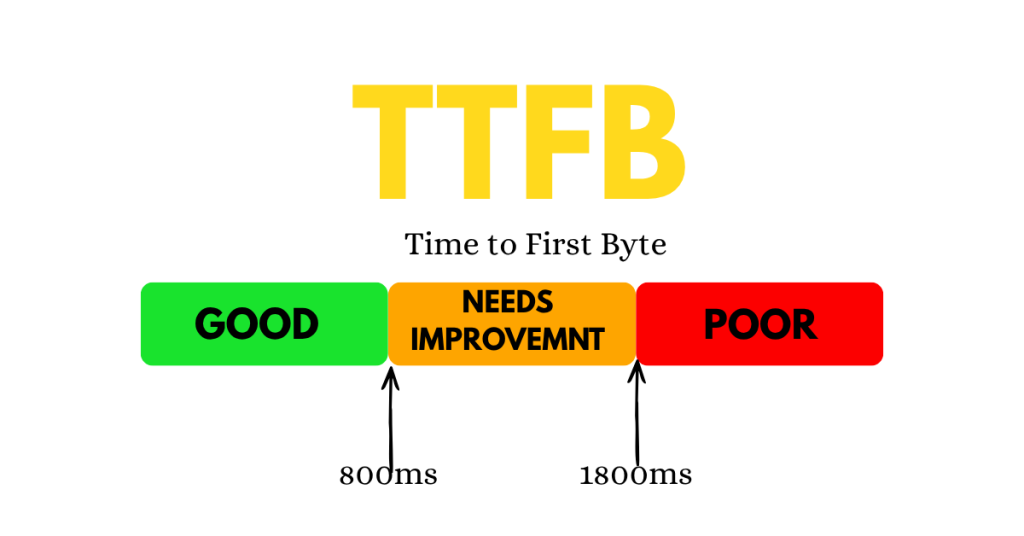
TTFB — Time to First Byte — is the measurement of how long it takes from the moment a browser sends a request to your server, to the moment the first byte of data comes back. It is the starting gun for everything that happens next on your page.
A high TTFB means everything is delayed from the very start. Even if your images are optimized, and your code is clean, a slow server response drags down your total load time. Google measures TTFB and factors it into page speed evaluations.
Good, fast website hosting minimizes TTFB by using powerful processors, efficient server software, and optimized configurations. A TTFB under 200 milliseconds is considered strong. Above 600 milliseconds, and you are in a territory that actively hurts your rankings and user experience.
This is one of the most direct ways hosting quality translates into SEO performance. Unfortunately, it is entirely outside your control unless you have good hosting underneath you.
9) It Improves Mobile Speed
Since 2019, Google has used mobile-first indexing for all websites. That means Google looks at your mobile version first when deciding how to rank you, not your desktop version. If your site loads slowly on a phone, your rankings suffer across all devices.
Mobile users are also less patient than desktop users. They are often on slower connections, in different locations, and moving between tasks. A site that takes four seconds to load on mobile loses most of those visitors before they ever see the content.
Fast hosting improves mobile load times by reducing server response time and delivering files efficiently, regardless of the device requesting them. Combined with a mobile-responsive design, strong hosting ensures your mobile performance meets the standard Google expects.
In a mobile-first world, slow hosting is a mobile-first problem.
10) It Enhances User Experience

Everything covered so far feeds into something broader: user experience.
Google has made it increasingly clear that how users feel when they use your site is a direct factor in how the site gets ranked.
Fast hosting creates smooth navigation. Pages appear when expected. Clicks respond instantly. There is no waiting, no layout jumping around, no half-loaded images. Users move through your site without friction.
That frictionless experience keeps people engaged longer, reduces frustration, and builds trust in your brand. And it sends every positive engagement signal back to Google, time on site, pages per session, and a low bounce rate. This reinforces that your site deserves to be ranked highly.
Slow hosting does the opposite. It creates friction at every interaction, and friction drives users away.
11) It Improves Site Reliability
Site reliability is about consistent performance over time, not just speed today, but speed every day, under different traffic loads, in different conditions.
An unreliable server crashes under traffic spikes.
- It slows down during peak hours when resources are shared.
- Delivers inconsistent response times that make your site feel unpredictable.
Search engines pick up on this inconsistency.
A site that performs well sometimes but poorly at other times does not build the trust that Google rewards with sustained high rankings.
Stable, reliable hosting delivers consistent performance whether you have ten visitors or ten thousand. That consistency builds search engine trust over time.
Trust is one of the hardest SEO assets to build quickly, but one of the most valuable to maintain.
How Truehost Improves Your Speed and Rankings
Truehost is built to deliver the performance that a fast website requires:
- Fast servers for quick load times
- High uptime for consistent reliability
- Optimized environments that reduce TTFB
- Scalable plans that grow with your traffic without slowing down.
Every feature Truehost offers connects back to the factors that matter to Google:
- Speed
- Stability
- Mobile performance
- Consistent availability.
You get the foundation that supports better rankings without having to piece it together yourself.
Conclusion
Fast website hosting boosts Google rankings because it improves every signal Google uses to evaluate your site:
- Page speed
- Core Web Vitals
- Bounce rate
- Engagement
- Crawl efficiency
- Uptime
- Mobile performance
All of these connect back to the server your site lives on.
You can write great content, build a clean design, and optimize every image, but if the hosting underneath is slow, you are fighting against yourself. The foundation has to be right first.
For reliable speed, strong uptime, and the performance your rankings need, choose Truehost. Head to Truehost now and put your site on hosting that actually supports your growth.